WTS Indonesia is a professional service firm focusing on the provision of Indonesian tax services. Equipped with decades of experience in dealing with complex Indonesian tax ecosystem, Tomy Harsono founded WTS Indonesia in 2019 where the firm started aiming to excel in the market from that point on
WTS Global News

WTS establishes hub for tax process and digitization consulting in Berlin
WTS establishes hub for tax process and digitization consulting in Berlin
WTS has opened its tenth German location in Berlin. From there, the international tax consulting company will centrally manage its consulting services for the digitization of tax and finance functions, and create a group-wide Digital Hub. This will be headed by Christian Baumgart (41). Karl Bevan (43) will assume the function of Chief Technology Officer (CTO) within WTS. Both digital experts joined WTS as new partners on 1 April.
“The process automation and digitization of tax and finance functions is one of our main topics. With our new Digital Hub, we will now establish a central hotspot for our digital consulting services. This applies both to our locations in Germany and internationally to all member companies of WTS Global,” explains Fritz Esterer, CEO of WTS.
In recent years, WTS has established itself as one of the leading service providers for the digitalization of tax and finance functions. The main growth drivers were tax process consulting and the development and implementation of tax tool solutions. With the founding of wtsAI, WTS has also accelerated the development of intelligent tax solutions using artificial intelligence methods for practical use.
Expansion of the Tax Technology Team
The new members Christian Baumgart and Karl Bevan strengthen the Tax Technology Team of WTS with immediate effect. Together with four other consultants, they have moved from KPMG to WTS and are responsible for setting up the Digital Hub.
Christian Baumgart has been working for KPMG in various positions on a national and international level since 2003. He specializes in the digitization of tax issues through process and transformation consulting as well as the implementation of IT tools. In 2008, he established a process and technology team at KPMG’s Berlin office, which he managed as a partner since 2010. In addition to projects in various tax disciplines, his focus was on HR and payroll functions. He advises clients from the strategy phase through planning to implementation.
Karl Bevan started his career as a software developer before joining KPMG in London in 2001. From 2008 he supported the development of the process and technology team at KPMG in Berlin and, as Director, was responsible for software development and implementation, product management of software solutions and the conception of technology strategies. He was also a member of KPMG’s governance and architecture boards for Global Mobility Technology. During his career, he has developed numerous local and global tax applications for international corporations.
“Digitization consulting is a cross-cutting topic that covers almost all tax areas. With our new Digital Hub, we are now creating a platform through which we can better serve our clients with digital solutions,” adds Fritz Esterer. “I am very pleased that we were able to win over Christian Baumgart and Karl Bevan. We will benefit greatly from their great expertise”.

WTS Global eyes strong presence in Middle East and Africa
WTS Global eyes strong presence in Middle East and Africa
WTS Global, a global network of specialized non-audit tax firms with representation in over 100 countries, for the first time convened its board meeting in Dubai recently with the aim to further strengthen its presence in the Middle East and Africa.
One of the board resolutions amongst others was to further continue on the path to becoming the “pre-eminent go-to-tax firm in Africa” and combine this strength with the expertise in the GCC region and beyond. With representation in 44 out of 56 African countries, WTS Global has an extremely strong presence in Africa which will be further leveraged.
WTS Global along with its UAE member firm WTS Dhruva Consultants hosted a high-profile client reception, which was attended by more than 50 clients representing UAE headquartered corporations, leading local and foreign banks, family offices and multinational corporations attended the event.
WTS Global Chief Executive Officer Wim Wuyts along with WTS Dhruva Consultants’ Chief Executive Officer Dinesh Kanabar welcomed the guests and thanked them for their special interest in learning how both firms can serve companies in dealing with the ever growing complex tax environment in the GCC region and internationally.
During the day there have been more than 20 one-to-one meetings between regional firms and WTS Global board members. WTS Global’s eight board members came to visit the office of its fast growing member WTS Dhruva Consultants, which was opened in 2017 and since then has grown to 40 professionals including three partners. WTS Dhruva Consultants offers single-window tax consultancy services to businesses that are in the process of adapting to the changing tax scenario in the Middle East.
“In the current constantly evolving tax environment, our clients expect from their advisors to not only understand the local tax environment but to offer them a holistic global view and give clear direction. For this they need tax advisors who are locally rooted in their home market, but are globally connected to serve clients across continents. This is the WTS Global model, where local firms from more than 100 countries are connected globally with the single aim to providing strong local expertise to clients with global tax needs,” said Wim Wuyts, Chief Executive Officer of WTS Global.
EDITOR’S NOTE:
About WTS Global
With representation in over 100 countries, WTS Global is a leading global tax practice offering the full range of tax services. WTS Global deliberately refrains from conducting annual audits in order to avoid any conflicts of interest and to be the long- term trusted advisor for its international clients. Clients of WTS Global include multinational companies, international mid-size companies as well as private clients and family offices.
The member firms of WTS Global are carefully selected through stringent quality reviews. They are strong local players in their home market who are united by the ambition of building a truly global practice that develops the tax leaders of the future and anticipates the new digital tax world.
WTS Global effectively combines senior tax expertise from different cultures and backgrounds and offers world-class skills in advisory, in-house, regulatory and digital, coupled to the ability to think like experienced business people in a constantly changing world.
For more information please see: wts.com
About WTS Dhruva
WTS Dhruva Consultants offers single-window tax consultancy services to businesses that are in the process of adapting to the changing tax scenario in the Middle East. Headquartered in Dubai, with an additional operational office in Bahrain, WTS Dhruva Consultants has a dedicated force of tax specialists working across sectors. WTS Dhruva Consultants is an affiliate of Dhruva Advisors, a leading tax advisory firm in India, which is known for its commendable work during the introduction of Goods and Services Tax (GST) in the country in 2017. WTS Dhruva Consultants has a formidable team with deep industry experiences across virtually all sectors including hospitality, FMCG, Oil & Gas, Real Estate, Insurance, IT and other financial services. The firm utilizes its rich industry experience seamlessly to provide business-focused and practical insights on VAT implementation and operations
For more information please visit: www.wts-dhruva.com

Russia Tax Congress WTS 2018
Russia Tax Congress WTS 2018
The Russian Tax Congress WTS, organized by ALTHAUS Group and WTS Global, was held at the Metropol Hotel on November 8. The main topic of the Congress was the future of corporate taxation.
The Congress was opened by Rostislav Shatenok, Managing Partner of ALTHAUS Group, and Wim Wuyts, СEO WTS Global.
The first panel session of the event covered the issues of future international taxation, new approaches in tax planning and structuring, issues of the transparency of the tax system, and digital solutions in the field of tax function management.
The speakers were Wim Wuyts, CEO of WTS Global, and Martin Ng, Managing Partner of WTS China. Igor Smirnov, Partner of the ALTHAUS Group Department of Corporate Taxation, moderated the session.
The second session of the Congress was devoted to digital economy. Experts told about the latest trends in the field of artificial intelligence and IT solutions for managing the tax function in the Baltic countries, Cyprus and Poland, tax breaks and special tax regimes for IT companies in Estonia and Poland, especially the taxation of intellectual property, and the VAT in digital services.
The speakers were: Nicholas Kipreos, Managing Partner of WTS Cyprus, Magdalena Saya, Member of the Board of Directors, Director of WTS Global, Managing Partner of WTS & SAJA Sp.z.o.o. (Poland), and Kärt Anna Mayre Kelder, Leading Tax Advisor for Sorainen (Estonia). Ekaterina Kurochkina, Manager of the Corporate Taxation Department of ALTAHAUS Group, moderated the second session.
In the third session, WTS partners from Germany and Luxembourg discussed the international tax landscape, the latest trends in international tax planning, and prospects for the development of measures to counter tax evasion at the international level.
Michael Boren, Advisor to Tiberghien International (Luxembourg), and Torsten Hopp, Partner at WTS Global (Germany), were the speakers at the third panel session. Vladimir Shchedrov, Director of Corporate Taxation Department at ALTHAUS Group moderated the session.
At the final, fourth session, the experts discussed the latest trends in the field of transfer pricing, the concept of permanent representation, as well as the modernization of approaches to international tax planning and structuring.
The speakers were Mike Hegmire, Partner of WTS Global (Germany), and Khan Ortwin, Partner of Atlas Tax Lawyers (Netherlands). Igor Smirnov, Partner of the ALTHAUS Group Department of Corporate Taxation, moderated the session.
The event was held in a format of several panels, where participants could not only hear the latest news in the field of corporate taxes, but also ask their questions.
The Tax Congress was attended by about 100 representatives of the largest Russian and international companies: financial directors, heads of tax departments, business owners, including representatives from Gazprom Germany, Rosenergoatom, VTB, Sberbank, RDIF, DHL, Alfa Group, the Far East Development Fund, Yves Rocher Vostok, Faberlic, and many others.
About
WTS Global is a global network of consulting companies, represented in more than 100 countries.
ALTHAUS Group is a leading Russian consulting company with more than 150 professionals in the field of finance, taxes, law, appraisal, and engineering. It is the exclusive partner of the global network WTS Global in Russia.

Are tax functions ready for Artificial Intelligence?
Are tax functions ready for Artificial Intelligence?
WTS and DFKI present an international AI study on the digital maturity of tax functions
Artificial intelligence (AI) in taxation is already a reality today. The prerequisite for this, however, is a sufficient digital maturity of the respective tax function, which must always be checked before using AI. The latest international AI study by the international tax practice, WTS Global and the German Research Center for Artificial Intelligence (DFKI) shows how the current status of digitisation is in taxation worldwide, and what a maturity model may look like in order to determine “AI readiness”.
As part of the study, WTS Global and the DFKI interviewed tax experts from a total of 34 countries on the digitisation status of tax functions by means of the international tax practice, WTS Global. In this regard, 85 per cent of the study participants stated that they were dealing with this topic in a professional context. However, the specific use of AI in taxation is currently only considered realistic by 5 per cent of those questioned.
“Tax functions have long recognised the need to digitise and automate tax processes, and are investing more and more in this area on an international scale. However, they are still reserved in terms of AI. Although intelligent tax solutions offer enormous potential, the organisational and IT infrastructures of most tax functions are not yet equipped for AI application”, explains Wim Wuyts, CEO of WTS Global.
Obstacles for artificial intelligence in taxation
For the application of AI in the field of taxation, certain conditions must be met. For example, the availability of data and the nature of data organisation play a decisive role. At this point, the discrepancy between the actual and ideal state becomes clear. For example, only 46 per cent of those questioned stated that their clients had tax-relevant data in digital form which could also be used for the purpose of process automation.
“The digitisation status of tax functions is very different. Especially when related to data as there is a great need for optimisation. For intelligent tax solutions to deliver their full potential, they need access to a unified data collection (“Tax Data Lake”). Often, however, separate data silos are used,” commented Prof. Dr Peter Fettke, Scientific Director of the study and the Competence Centers Tax Technology at the DFKI.
Other challenges identified included the lack of a clear digitisation strategy and the lack of a budget for its implementation. According to study participants, this applied to about two-thirds of all clients. But even the fact that business processes in tax departments are not always completely digitised by IT systems is a limiting factor – this is only the case for 18 per cent of companies.
Anyone wishing to use AI, not only needs new technologies and solutions, but also has to build up appropriate know-how on behalf of their employees. Many of the tax experts questioned had a basic understanding of AI, but no experience in greater detail in this area. As a result, AI training and a corresponding change management process are gaining in importance.
When intelligent tax solutions are used and what they do
With intelligent tax solutions, tax functions are able to set new standards in terms of quality, efficiency, compliance and cost savings. The application areas are currently focused on certain tax disciplines, in which large amounts of data are processed and the tax tasks are highly repetitive – such as wage tax, VAT, transfer pricing or customs. For example, process mining methods can detect errors and anomalies in mass transactions that are difficult for humans to detect.
“The study revealed a great need for approaches to uncovering unknown process patterns and anomalies. The process mining methods can be used precisely on this occasion, in order to identify real process flows and, for example, with regard to compliance issues. To assess the conditions for the use of AI processes, such as process mining, and to develop them specifically, a maturity model helps,” says Tim Niesen, who is writing his doctoral thesis at the DFKI on AI maturity models in the tax department.
Getting AI Ready with the maturity model by WTS Global and the DFKI
Conducting a study on the degree of maturity is an important basis for being able to use AI later on and to become AI Ready. With that in mind, WTS Global and the DFKI have developed a systematic assessment methodology for assessing the digital maturity of tax functions based on the study results. At its core, this is divided into four categories: Strategy, Data, Processes and Technology. This makes it possible to identify drivers and obstacles of digitisation in tax functions and to obtain a detailed overview of their digitisation status in the four areas.
“Before tax functions start purposefully with AI, they first have to become aware of their digital maturity. For this purpose, we have developed a model with which we can capture the digitisation status of tax functions, identify AI potentials and finally derive recommended actions for AI readiness,” says Vanessa Just, Project Manager, Artificial Intelligence at WTS Germany and Managing Director of wtsAI.
In the future, by means of the wtsAI joint venture which we founded in mid-2018 with the advanced analytics specialist, QUNIS, WTS Germany will conduct maturity research into corporate tax & finance and help companies to achieve AI readiness.

Webinar: Energy and Consumption Tax: New official forms for tax registrations and tax reliefs in 2020
Webinar: Energy and Consumption Tax: New official forms for tax registrations and tax reliefs in 2020 (in German)
Effects of the Corona crisis on the Application Process
24.04.2020 | 12.05.2020
10:00 – 11:00 | 09:00 – 11:00
We cordially invite you to our webinar on “Energy and Consumption Tax: New Official Forms for Tax Declarations and Tax Reliefs 2020 – Effects of the Corona Crisis on the Application Process”, which is held in German language.
The Corona virus quickly plunged the German economy into a crisis. The German government has decided to take far-reaching measures to mitigate the economic impact of the pandemic. Excise duties, e.g. Energy tax, electricity tax, alcohol tax, and air traffic tax can be applied for to defer the effects of the corona crisis, tax deferrals, postponement of enforcement and the adjustment of advance payments. As state support measures, emergency aid is subject to the requirements of EU state aid law. The crisis can also lead to a classification as a company in difficulty according to the official form 1139. It is currently under discussion whether this will result in the loss of tax breaks for energy and electricity taxes.
In addition, the regular application requirements for energy and electricity tax continue to be met. The customs administration has so far not granted any general deadlines for tax declarations and tax relief applications due to the Corona crisis. At the turn of 2019/2020, the customs administration extensively revised the official forms in the area of energy and electricity tax. The new concept for the implementation of forms by the General Customs Directorate is intended to reduce the programming effort for the IT project MoeVe Zoll 2016 and the adjustment effort when the legal framework changes. The forms are mainly based on clear and reusable decision questions (yes / no). In addition, they already have field functions that guide the applicant in completing them.
Registration
Please register here.
In case of any questions or comments please contact us under: news@wts.com.
Your WTS Global Team
Our Speaker(s)

Düsseldorf

10% VAT on cross-border e-commerce transactions
10% VAT on cross-border e-commerce transactions
- Levied to Indonesian customers
- On consumption of movies and music streaming services, mobile apps, online games, and other intangible goods and services
- Foreign e-commerce companies to be appointed as VAT collector
- Effective 1 July 2020
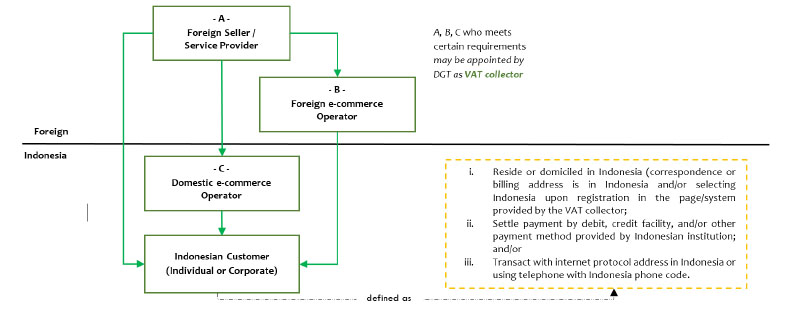
Mechanism
- VAT is liable upon consumption of taxable intangible goods and/or taxable services from outside Indonesia customs area through electronic system by Indonesia customers.
- VAT is collected upon payment by Customer, where VAT collector to issue VAT collection slip that can be in the form of: commercial invoice, billing, order receipt, or other documents.
- VAT collector to settle collected VAT by the end of the following month to the state’s treasury account. VAT collector may settle the VAT in: Rupiah, USD, or other foreign currency as determined by DGT.
- VAT collector must electronically submit report on the VAT collection, quarterly for 3 periods. DGT may request VAT collector to submit transaction-details report for every 1 calendar year.
Intangible Goods and Services
- Intangible goods, including but not limited to:
- The use of or the right to use any copyright of literary, artistic or scientific work, patent, design or model, plan, secret formula or process, trademark, or the form of intellectual/industrial property right, or other any kind of right.
- The use of or the right to use motion picture films, film or video tape for television broadcasting, or sound tape for radio broadcasting.
- Digital goods are any intangible goods in the form of electronic or digital information, including goods as the result of conversion or transformation or goods originally in the form of electronic, including but not limited to software, multimedia, and/or electronic data.
- Services include:
- any taxable services and digital services, i.e. services sent through internet or electronic network, that are automatic or having less human intervention, and impossible to ensuring without information technology, including but not limited to software-based services.
Your Contacts
- Tomy Harsono
+62 811 9196 939
tomy.harsono@consulthink.co.id

This publication is intended for general information only and should not be interpreted as substitute to any of our professional advices. All of information contained in this publication refers to the featured regulation as per the date of this publication.
info@consulthink.co.id
www.wtsindonesia.com
Consulthink LinkedIn
+62 21 506 789 68